


The New Thinking Behind Branded Entertainment
At the end of September, our owner and CEO Kim Notz moderated a panel on precisely this topic at the Creativity Summit at dmexco: “Entertainment First. Brand Last?” Joining her were Robin Blase, creator and media critic; Daniel Hoffmann, Managing Partner at Serviceplan Social; Francesca Lange, Head of Group Media & Digital Marketing at Bahlsen; Peer Wörpel, Managing Partner at la red; and Tino Krause, Regional Director Central Europe at Meta. Twenty-five minutes, five perspectives spanning creators, brands, agencies and platforms, and one shared conclusion: Branded entertainment has become an established part of the industry conversation. Yet very few know how to approach it systematically and get it right.
Kim Notz
24. September 2026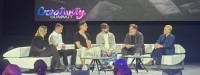
This is rarely down to a lack of budget. More often, brands repeat two structurally similar mistakes. The first is trying to become a media company overnight, with a team that was briefing campaigns yesterday and is suddenly expected to produce formats on a weekly basis. The second is treating entertainment like a campaign, with a launch, a four-week run and a post-campaign evaluation. Both mistakes cost money.
No Brand Needs to Become a Media Company
The YouTube success of the German Armed Forces series “Die Rekruten” is often cited as a blueprint, but the real lesson is remarkably straightforward: the agency released five-minute episodes five days a week, at the same time, for twelve weeks. That is an editorial publishing schedule, not a six-video launch followed by radio silence. The result: 44 million views, three quarters of them organic, and ultimately a 20 percent increase in applications. Most marketing departments lack this kind of discipline, rarely because they are incapable, but because they were simply never built for it. Editorial teams think in seasons; marketing teams think in campaign cycles.
An owned channel is still worthwhile, but as a home, not a broadcast studio. In Germany alone, YouTube reaches 57 million people aged 16 and over every month, according to Gemius data. Brands that operate their own channel retain the audience relationship and their first-party data, rather than handing both over entirely to third-party platforms and individual creator partnerships.
Strategic Loss of Control
The second rule is more uncomfortable because it is an organisational question, not a media question: brands that want to create entertainment need to work with people who genuinely understand the creator mindset. In most cases, that means either tapping into an existing format that already works or developing a new one together with people who are already at home in the genre. Bahlsen’s PickUp! brand built its dating podcast “UP!Date” from the outset with people who already understand dating content.
The UK supermarket Waitrose shows how far this principle can go with its podcast “Dish”. Angela Hartnett and Nick Grimshaw invite guests such as Stanley Tucci or Hugh Bonneville into their home, cook together and talk about what is on the table. Waitrose never pushes itself to the foreground as a brand. The ingredients come from its own range, and the recipes are subsequently published on the Waitrose website with product links. This level of restraint is only possible when the brand team stays out of the show itself and leaves the creative decisions to the people making it.
Measuring ROI the Right Way
Working this way also requires a different approach to measurement. Reach and downloads only tell you whether something was seen or heard, not whether it had an impact. With “Dish”, the picture becomes clearer beyond the headline figure of one billion downloads, views and streams: on average, 97 percent of listeners finish an episode, the podcast has a 4.9 out of 5 rating on Spotify, and 36 percent of listeners say they regularly shop at Waitrose. Completion rate, sentiment, returning viewers, subscriber growth and, where measurable, actual purchasing behaviour are the metrics that show whether a brand is building what Byron Sharp calls mental availability, or merely attracting short-term attention.
It also takes a kind of patience that is alien to traditional media-planning logic. Formats build audiences the way TV series build ratings, over multiple seasons. Anyone expecting results after just four weeks is, in reality, simply repackaging the old campaign logic under a new name.
Paid media does not become obsolete; it simply takes on a different role. Once a format has gained organic traction, targeted amplification can accelerate growth without replacing the format’s underlying logic. “Organic creates credibility, paid media builds scale,” as the English-language trade press succinctly puts it. According to the IAB Outlook Study 2026, 57 percent of advertisers now rank influencer advertising as a top investment priority, a marked increase from 48 percent the previous year. The sequence is what matters: first, the format earns attention; then paid media amplifies it.
Ultimately, much depends on whether marketing leaders are willing to question their own need for control as rigorously as they question the media plan. In the creator era, the brands that succeed are the ones that know how to be good hosts.